Clem and Jody
Naked LunchClem and Jody are old vaudeville performers turned Russian agents whose public role, commercial schemes, and deliberately outrageous routines make them recurring figures in the book’s satire of political allegiance and global trade. They present themselves as agents working to discredit the United States, but their actions are driven by private profit: most consequentially, they sell contaminated wheat that devastates the Republic of Hassan and condemned parachutes that kill Ecuadorian airmen. Their performance never resolves into a stable distinction between political mission and business opportunity; both become parts of the same act.
Identity and Operating Style
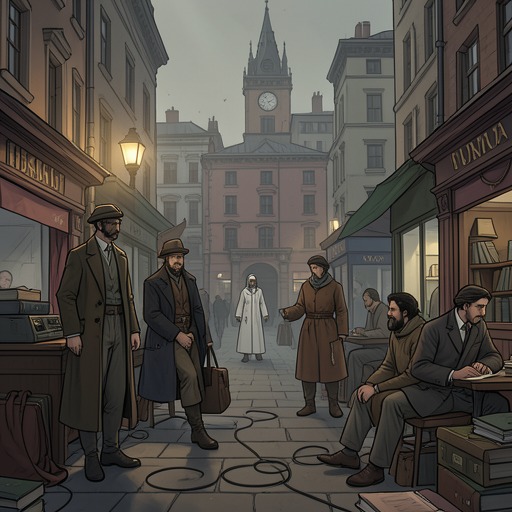
Clem and Jody are introduced as the Ergot Brothers, a name that foreshadows the wheat-borne disease associated with their most destructive scheme. They are described as two old-time vaudeville hoofers who have taken on the role of Russian agents, ostensibly to represent the United States in an unfavorable light. Their act is not discreet intelligence work. They cultivate conspicuous scandal and stage crude provocations, inviting crowds to follow them in expectation of another outrage.
Their appearance and manner belong to that public performance. They pace around bidonvilles smoking enormous cigars and discuss clearing the settlements with bulldozers, treating inhabited neighborhoods as obstructions to be removed. The crowds that trail them do not simply witness political activity: they gather in hope of seeing an especially outrageous spectacle. Clem and Jody thus become performers whose audience helps turn insult into a public event.
Political Cover and Private Interests
The pair’s stated political function conceals a shifting set of commercial interests. They say they support the destruction of oil fields in the Near East because it would raise the value of their Venezuelan holdings. Their conduct is consequently not presented as a coherent ideological program. Political agitation supplies a cover and an opportunity, while the anticipated effect on their property supplies the business rationale.
Their wider schemes reinforce that picture. At the gatherings associated with Islam Inc., the account places Clem and Jody among figures whose contributions and affiliations are not equivalent to commitment to the organization’s policies. The organization’s precise objectives are described as obscure, and participants are expected to pursue competing aims. In this environment, association is itself a maneuver: political causes, advisory roles, and subsidiary interests can be invoked without binding the people who profit from them.
Clem’s complaint about the demands of their routine makes the performance’s multiple parts explicit. He lists the tasks he is expected to combine: dispossessing a bidonville, obtaining heroin, urinating on the Black Stone, making the prayer call in a pig costume, and canceling Lend-Lease. He objects that the routine requires him to perform too many parts at once. The joke depends on treating geopolitical provocation, religious insult, and personal indulgence as items in an overburdened vaudeville turn; it also exposes the calculated labor behind their apparent spontaneity.
The Wheat Scheme and Its Consequences
The most consequential episode begins with a dubious wheat deal in Panama. Clem and Jody say they acquired the cargo from a woman who had inherited it after a Finnish skipper died in a local establishment. They claim to have paid ten pieces of heroin for it, describe it as good Aleppo heroin, and joke that the wheat had just enough milk sugar to preserve its strength. Their account makes the transaction sound like an improvised bargain, but its destination gives it lethal consequences.
On reaching the Republic of Hassan, they serve couscous made from the wheat at a banquet for the Caid. Clem and Jody confirm that the diners became intoxicated during the meal, while claiming that they themselves ate bread and milk because of ulcers. The banquet therefore serves as both a social occasion and the point at which their merchandise enters public life. The narration identifies them as having devastated the Republic with poisoned wheat, connecting the joke about a suspect cargo to large-scale harm.
The explanation of ergot clarifies the name Ergot Brothers and the danger attached to the shipment. Ergot is a fungal disease affecting bad wheat; its outbreaks in medieval Europe were called St. Anthony’s fire, and ergotism could lead to gangrene and the loss of limbs. This account supplies a historical and bodily consequence for the brothers’ commodity scheme without turning their salesmanship into an abstract metaphor: the wheat is dangerous because contamination can produce severe disease.
Other Ventures and Narrative Significance
The wheat is not an isolated failure of judgment. Clem and Jody also unload condemned parachutes on the Ecuadorian Air Force. During manoeuvres, the parachutes fail, and airmen fall to their deaths while the pair escape over the Andes in a jet. The sequence gives their commercial opportunism a direct and visible consequence: they sell equipment known in the account as condemned, the military exercise becomes fatal, and the sellers get away.
The contrast between vaudeville and commerce sharpens the character of their episodes. Their dialogue packages serious consequences as a routine, while the narrative records poisoned food, contaminated trade, and failed parachutes. They do not simply make jokes about an unstable political world; they exploit its institutions and conflicts as markets. Their Russian-agent identity, stated interest in American discredit, and declared concern for oil holdings coexist without forming a trustworthy public purpose. Clem and Jody’s significance lies in that deliberate confusion: in their hands, political theater and international business become inseparable performances, and the people beyond the stage bear the costs.